
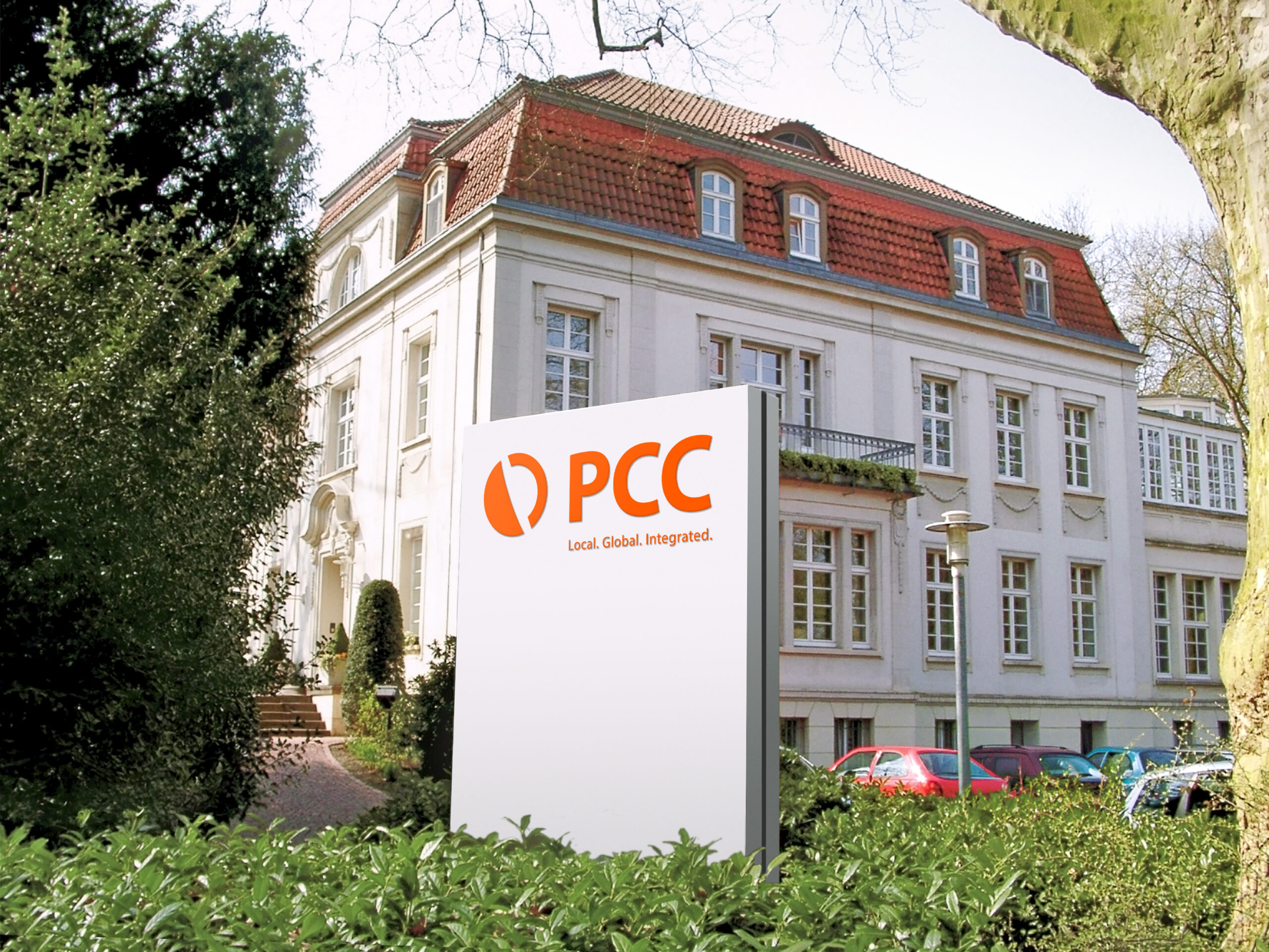
PCC. Local. Global. Integrated.
Headquartered in Duisburg, Germany, PCC SE is the investment holding company of the globally active PCC Group with around 3,400 employees. Its Group companies have core competencies in the production of chemical commodities and specialty chemicals, as well as in the field of container logistics. Als langfristig orientierter Investor konzentriert sich die PCC SE darauf, durch nachhaltige Investitionen die Unternehmenswerte ihrer Beteiligungen kontinuierlich zu steigern und beständig neue Werte zu schaffen. Die größten Chemieproduzenten der PCC-Gruppe sind die PCC Rokita SA, ein bedeutender Chlor-Hersteller und Osteuropas führender Produzent von Polyolen, sowie die PCC Exol SA, einer der modernsten Tenside-Produzenten in Europa. PCC was founded in 1993 by Waldemar Preussner, sole shareholder of PCC SE, who is now Chairman of the Supervisory Board. In fiscal 2025, the PCC Group generated consolidated sales of € 923.6 million and consolidated earnings before interest, taxes, depreciation and amortization (EBITDA) of € 81.4 million. The investment volume in 2025 amounted to 173.8 million euros.
Group strategy
PCC SE actively manages its portfolio of companies, ensuring the development of the holding’s subsidiaries. This work centers on the acquisition of new portfolio companies, as well as the development of existing activities and projects. Our focus is to establish ourselves in less competitive sub-markets and market niches. We continue to invest mainly in the emerging markets of Central, Eastern, and South Eastern Europe, but we also concentrate on gaining entry to growth markets on other continents, primarily in Asia.
On the other hand, PCC can decide to divest operations where disposal offers attractive gains, and the released funds can be used to drive other core activities. The holding company will also dispose of portfolio entities where these are unable to generate satisfactory returns or no longer offer attractive development potential.
Corporate philosophy
We consider our principles the mission-critical foundation of a sustainable position for PCC in an environment of increasing globalization and ever more rapidly changing markets. They enable us to occupy lucrative niches in a growing number of sectors and industries, to increase our profits through higher efficiency, and to continuously optimize our company Portfolio.
We consistently work to open up new business areas and product ranges as they become available to us. Our decisions in this respect always reflect the current market situation. We assess earnings potential through conservative and risk-sensitive analysis. When making our choices we always look for opportunities where sustainable growth and steady cash flows can be expected.
Group segments
Basic Values and Code of Ethics
Here you can find our core values and our code of ethics to read and download: https://pcc.eu/wp-content/uploads/pdf/grundwerte-pcc-se.pdf
Preamble
In our actions, we strive for the highest standards of conduct and act according to the core values explained below, which apply to the entire PCC Group.
Core Values
1. customer sensitivity
‘ We always keep a close eye on our customers’ needs, because knowing them allows us to identify and exploit market opportunities and develop new business ideas.
‘ We maintain close and lasting contacts with our customers, continuously expanding and deepening them.
‘ All customers are partners to us. Together we flexibly define the rules for our cooperation.
› We support our customers in difficult times for them.
2. Honesty and Credibility
› We act according to the principles of the honorable merchant.
› We realistically assess our possibilities and communicate this transparently to our stakeholders.
› We earn the trust of all our partners through reliability and credibility in our actions.
3. Initiative and Commitment
› We work with initiative and support each other at all organizational levels.
› We take on challenges with commitment and clearly express our own opinions.
› We achieve set goals through both joint dynamic action and our personal commitment.
› Together, we create the conditions for successful work that satisfies us and all our partners.
4. Mutual Appreciation and Partnership Collaboration
› Based on our cultural and professional diversity, we support and complement each other in our work, thereby promoting our group affiliation.
› We treat all colleagues with respect and as partners, regardless of their position in the group of companies.
› We build positive interpersonal relationships and treat others as we would like to be treated ourselves.
› We willingly share our knowledge, experiences, and information with all interested employees, as this makes an important contribution to the development of our company and further increases the effectiveness of our work.
› Employees who share their knowledge with their colleagues are held in high esteem. Such attitudes strengthen their position within our Group and shall in no way be allowed to be detrimental to them.
Code of Ethics and Conduct
PCC SE is an investment company and the holding company of the PCC Group. The company has a stable and future-oriented investment portfolio in the chemicals, energy and logistics sectors. The majority of its sites are located in Europe. The PCC Group is also represented in the USA, Thailand and Ghana.
The PCC Group provides services on a high technical and qualitative level on an international scale and is at the same time a reliable and integral partner of all stakeholders.
PCC is convinced that sustainable business success is closely linked to compliance with laws and regulations as well as ethical standards.
For this reason, PCC has drawn up stringent and strict rules relating to all that we do as an enterprise that are set down in this Code of Ethics. The Code is supplemented by detailed internal guidelines.
PCC does not tolerate any infringement of this Code. Employees are required to comply with the principles described here at all times and to report any non-compliant behaviour to PCC’s Compliance Department. PCC guarantees the utmost confidentiality in this regard.
Scope
1. The Code of Ethics and Conduct applies to all business areas, the Administrative Board/Supervisory Board, the Managing Board/Executive Board/Management and all employees (hereinafter “employees”) of PCC SE and its group companies (hereinafter “PCC”), regardless of their function, position or location.
2. The Code of Ethics and Conduct furthermore also applies to the employees of joint venture partners where a PCC Group company is responsible for business management.
3. The term “employees” and similar terms naturally refer to both genders in all cases.
4 All employees are obliged to comply with the Code of Ethics and to base their actions on the following principles. Violations of the Code will be sanctioned.
Legal Compliance
1. Employees must observe and comply with all laws, regulations and internal guidelines of PCC applicable in their work environment.
2. This applies also to national and international laws that restrict or prohibit the import, export or domestic trading of goods, technologies or services and of capital and monetary transactions.
3. Employees must observe all relevant trade-control regulations whenever goods are purchased, manufactured or put onto the market or whenever technologies are transferred or received.
4. In the event that deviating requirements, laws or regulations exist on account of differing legal systems or national conventions in dayto-day business, then the most stringent regulations must be adhered to in all cases.
5 Every employee is obliged to inform themselves about the legal obligations, instructions, guidelines and framework conditions that are relevant to their area of work and responsibility. If employees have doubts about the current legal situation in individual cases, they should consult their line manager or the responsible compliance officer.
Conflicts of Interest
1. employees must act at all times in the best interests of PCC and avoid situations in which personal interests conflict or could conflict with the interests of PCC. Personal interests also include the interests of family members and comparable persons within the meaning of this Code.
2. Potential conflicts of interest involving PCC and employees are described in detail in a PCC guideline.
3 Conflicts of interest can also arise in business transactions when conflicting interests of several parties must be taken into account. In such cases, employees must consult their line manager or the responsible compliance officer.
Corruption
1. PCC does not tolerate any form of active or passive bribery.
2. Potential corruption situations are described in detail in a PCC guideline.
3. business relationships with suppliers and business partners must be conducted exclusively on the basis of objective, commercial criteria. Personal interests must not play a role in this.
4. The ban on accepting and granting advantages relates not only to direct financial benefits, but also to other privileges that could cast doubt on commercial impartiality.
5 With regard to the acceptance and granting of benefits, gifts or invitations, the PCC guideline
as well as the tax regulations and relevant approval requirements apply. These must be complied with.
Money Laundering
1. PCC strictly prohibits all employees from becoming involved in or tolerating any actions in their work environment that violate domestic or foreign money laundering regulations.
2. money laundering means in particular the smuggling – for example through exchange or transfer – of funds or other assets derived directly or indirectly from criminal offenses into the legal economic cycle. This also applies if the origin of the funds is unclear.
3. violations of the money laundering regulations may result in criminal sanctions for the employee. If there is any doubt about the permissibility of a financial transaction, the Compliance Officer must therefore be consulted at an early stage.
Social Engagement
1. entrepreneurial activity is closely linked to social responsibility. This responsibility is reflected at PCC in its involvement in the areas of social welfare, education and science, sport and culture.
2. sponsorship funds are only granted on the applicable legal basis. In addition, the approval of the Executive Management Board of PCC SE or the Management Board or management of the respective Group companies is required.
3. Monetary payments and other non-cash benefits granted to politicians, political parties, political associations or other political organizations are strictly prohibited.
Inside Information
1. Employees who possess so-called inside information about PCC or other companies with which PCC is considering a strategic alliance, acquisition, divestment or merger, may not buy or sell their securities or derivatives as long as this information is not accessible to the general public.
2. Insider information includes all information that is not known to the public and that an investor would consider important with respect to the decision for or against the purchase or sale of securities or derivatives.
3. insider information may not be passed on to third parties. Even within PCC, insider information may only be passed on if the recipient of the information needs it to carry out their work at PCC.
4. the use of insider information may have consequences under criminal law. In cases where employees are not sure whether they have insider information, they must consult their line manager or the responsible compliance officer.
Confidentiality
1. PCC employees are obliged to maintain absolute confidentiality both during the term of their employment relationship with PCC and after its termination with regard to all business secrets and all other confidential information about PCC that the employees have gained knowledge of in connection with the performance of their duties.
2. Confidential information includes information about PCC’s business activities, technology, intellectual property, financial position and workforce as well as all information about PCC’s customers, suppliers and business partners.
3. confidential information may not be passed on to third parties. Even within PCC, confidential information may only be passed on if the recipient of the information needs it to carry out their work at PCC.
4. confidential information and business documents must be protected in an appropriate manner from being viewed by third parties and colleagues who are not involved. This also includes marking e-mails in internal electronic communication as “confidential” or “strictly confidential” if necessary.
5. Moreover, confidential information may only be made public if the related information is known to the public, its publication has been approved by PCC or publication is required on account of a legal obligation.
6. data and information relating to customers, business partners and market participants must be treated as strictly confidential. Every employee is obliged to use data and information that comes to their knowledge in the course of their work exclusively within the permitted framework. When passing on data within and outside the company, it must be checked whether the addressee is authorized to receive it.
7. Data and information about the above-mentioned groups of persons and companies may only be collected, processed and used within the scope of its intended purpose, the principle of necessity and legal justification.
8. Employees’ personal details are treated with the utmost care within the scope of workforce data-privacy legislation.
Information Systems/Software
1. the provision of e-mail and Internet access is for business purposes. The use of e-mail as a means of business communication is subject to the same archiving rules as correspondence on paper.
When sending e-mails, the same duties of care and etiquette must be observed as for correspondence on paper.
2 PCC has purchased software for all workstations under the applicable license conditions. Employees are not permitted to copy such software protected by license agreements for private purposes, nor conversely to install private software at the workplace.
3. employees may make limited personal use of the Internet connection and PCC’s e-mail infrastructure, provided that this does not impair their work performance, does not create or increase a security risk and does not use significant resources. All e-mails are then considered business e-mails.
4. Employees must not under any circumstances misuse PCC’s information and communications media for illegal or unethical purposes.
Reporting
1. PCC attaches great importance to complete, correct, timely, accurate and understandable periodic financial statements and corresponding financial reporting and communication. As part of their professional duties, all employees working in finance at PCC are responsible for ensuring that effective procedures and internal controls are established and maintained for financial reporting and the publication of disclosable facts.
2. the statutory regulations, in particular the accounting principles, and PCC’s internal accounting procedures must be strictly complied with. Dishonest reporting within the company or to other organizations or persons is prohibited.
Intellectual Property
1. inventions, patents, trademarks, knowledge and other intellectual property of PCC are of particular importance for the long-term success of the company. PCC’s intellectual property must therefore be protected in the best possible way.
2. Patents, trademarks, knowledge and other intellectual property belonging to third parties must be respected in all cases.
3. If employees are uncertain in individual cases whether intellectual property belonging to PCC or third parties could be affected, they must consult with their line manager or the competent Compliance Officer.
Business Property
1. PCC’s business property may only be used for business purposes. Employees shall treat PCC’s business property with care and protect it appropriately against loss, damage, misuse, theft, embezzlement and destruction. Work equipment, machinery and other technical equipment and facilities as well as vehicles must be operated in a professional manner.
Fair Competition
1 PCC aligns its business policy to the criteria of fair and performance-oriented competition. Compliance with competition law regulations is an integral part of PCC’s corporate policy and is expected of all employees.
2. Employees must comply with all applicable regulations relating to competition law and must reject any measures that could lead to unfair competition.
3. Employees must comply with all applicable regulations relating to cartel law.
4 Due to the complexity of antitrust legislation, all agreements with competitors or other third parties that could have a negative impact on competition must be submitted to PCC’s legal department in advance. The legal department must also be contacted at an early stage in other cases of doubt.
Interaction with Employees
1 PCC recognizes the four basic principles of the International Labour Organization (ILO). These are freedom of association and the right to collective bargaining, as well as the rejection of forced labor, child labor and discrimination.
2. All employees have a right to fair, courteous and respectful treatment.
3 PCC does not tolerate any discrimination or harassment of employees, whether in direct contact, in correspondence, electronically, verbally or in any other form. Discrimination or harassment based in particular on race, religion, origin, gender, disability, age, marital status, sexual orientation or membership of trade unions or political parties is not permitted.
4. the provisions on equality between men and women must be complied with. Equality includes in particular areas such as the allocation of tasks, remuneration, training and further training and promotion.
5 Any form of sexual harassment in the workplace is prohibited. Sexual harassment is defined as any behavior with a sexual connotation that is unwelcome to the employee concerned and that diminishes his or her dignity.
6. bullying as deliberate exclusion and humiliation of an employee is not tolerated. Bullying is defined as systematic, persistent or repeated hostile behavior with the purpose of isolating a person in the workplace and in the workforce or even isolating them from the workplace.
7 PCC takes all reasonable measures to prevent discriminatory or harassing behavior. All employees are called upon to report any discrimination or harassment observed in their working environment to their line manager, the HR department or the Compliance Officer.
Environment, Health, Safety
1. environmental protection is a top priority at PCC, alongside the safety of our employees. This awareness determines the choice of production processes and products and the commitment to promoting sustainability and safety.
2 PCC strives to minimize the consumption of raw materials and energy in its production processes and is continuously engaged in the assessment and improvement of its working methods, production processes and products. This ensures that they are safe and acceptable for employees, customers, the public and other stakeholders.
3. In the event of accidents or operational malfunctions, PCC will implement the necessary measures for preventing hazards and repairing damage and inform the relevant authorities as quickly and efficiently as possible.
4 Every employee shares responsibility for the protection of people and the environment in their working environment. The laws, regulations and internal guidelines on environmental protection, health and plant and occupational safety must be strictly complied with at all times. Every line manager is obliged to instruct, supervise and support their employees in fulfilling this responsibility.
5 As a rule, the commercial use of natural resources such as air, water and soil may only take place within the framework of a previously granted permit. The same applies to the construction and operation of production facilities and their modification or expansion. Any unauthorized release of substances must be avoided.
6. waste must be disposed of in accordance with the statutory regulations. If third parties are engaged for this purpose, it must be ensured that they also comply with the environmental regulations and the corresponding requirements of PCC.